Petrol vs. Diesel Cars: A Comprehensive Guide to Their Key Differences






Key Highlights
-
Diesel engines offer better fuel efficiency and are ideal for long drives and heavy-duty tasks.
-
Petrol cars provide smoother city driving, quicker acceleration, and lower initial costs.
-
Diesel engines generally last longer but have higher maintenance costs and emissions.
-
Petrol engines are more affordable and easier to maintain, with lower emissions in urban areas.
-
Government regulations and taxes can influence your choice, with diesel cars facing stricter emission norms in some regions.
Choosing between a petrol or diesel engine is a vital decision when purchasing a car. Each option offers distinct features, benefits, and drawbacks in terms of performance, cost, and usage.
This guide breaks down the key differences to help you select the best fit for your needs.
Fuel Efficiency
Diesel Cars: Known for outstanding fuel efficiency, diesel engines use 20-30% less fuel than petrol engines over the same distance. They are an excellent choice for long-distance driving and high-mileage users looking to reduce running costs.
Petrol Cars: While less fuel-efficient than diesel, petrol engines are ideal for short commutes and city driving. Their lower upfront cost and widespread availability often compensate for higher fuel consumption.
Engine Performance
Diesel Cars: Diesel engines offer superior torque, making them ideal for towing heavy loads and handling tough terrains. This torque advantage ensures consistent performance at low RPMs, perfect for highway travel and off-road activities.
Petrol Cars: Petrol engines shine in providing rapid acceleration and a smoother driving experience. With higher revs and more power per unit of displacement, they are well-suited for sporty and dynamic driving preferences.
Maintenance & Durability
Diesel Cars: Diesel engines typically incur higher maintenance costs due to intricate components like particulate filters and advanced fuel injection systems. However, their robust design enables them to endure greater stress and often exceed 300,000 miles with proper upkeep.
Petrol Cars: Petrol engines feature a simpler design, leading to lower maintenance expenses and easier repairs. Though their lifespan is generally shorter than diesel engines, they remain dependable for moderate use.
Environmental Impact

Diesel Cars: Contemporary diesel engines generate lower CO2 emissions compared to petrol engines, helping to minimize greenhouse gases. However, they release higher amounts of nitrogen oxides (NOx) and particulates, which can adversely affect air quality.
Petrol Cars: Petrol engines emit lower levels of particulates and nitrogen oxides (NOx), making them less detrimental to urban air quality. However, they produce higher CO2 emissions, which contribute to climate change.
Cost Of Ownership
Diesel Cars: Diesel vehicles typically have a higher initial cost due to advanced engine technology. While they provide better mileage and lower fuel costs per mile, the upfront price and maintenance expenses may reduce overall savings.
Petrol Cars: Petrol cars are more affordable upfront, appealing to a wider audience. Their lower maintenance expenses further enhance their cost-effectiveness.
Engine Longevity
Diesel Cars: Built for durability, diesel engines feature robust designs that can withstand higher compression ratios, making them ideal for high-mileage drivers.
Petrol Cars: Although petrol engines typically have a shorter lifespan than diesel, they are well-suited for drivers with moderate annual mileage.
Driving Experience & Noise Levels
Diesel Cars: Diesel engines offer a quiet and smooth performance on highways but can feel less agile in city traffic due to their lower RPM range.
Petrol Cars: Petrol engines are quieter when idling and provide a smooth, responsive drive in urban environments, with high-revving capabilities adding to the driving enjoyment.
Resale Value

Diesel Cars: Diesel vehicles generally retain higher resale value due to their fuel efficiency and durability, making them a popular choice for buyers looking for long-term savings.
Petrol Cars: Petrol cars tend to depreciate more quickly than diesel cars, but their lower upfront cost and broad popularity help maintain steady demand in the used car market.’
Government Policies & Taxes
Government regulations and tax policies can impact the decision between diesel and petrol cars. Diesel vehicles may incur higher taxes or restrictions in certain areas due to environmental concerns, while petrol cars are typically subject to fewer regulations.
Availability & Market Trends
Diesel Cars: Diesel vehicles are favored in regions with long-distance travel and heavy-duty use but are losing market share in some areas due to stricter emission standards.
Petrol Cars: Petrol cars are more prevalent, offering a broader selection of models and features, and are the preferred option for urban and suburban drivers.
How to Choose Between Diesel and Petrol Cars?
Your decision should depend on your driving patterns, budget, and environmental concerns:
Go for a diesel car if:
- You often drive long distances.
- You need a vehicle for towing or heavy-duty tasks.
- Fuel efficiency is more important than the initial cost.
Choose a petrol car if:
- You mostly drive short distances or in the city.
- You want a more affordable, low-maintenance vehicle.
- You prefer a more responsive driving experience.
Verdict
Choosing between diesel and petrol cars depends on your specific needs and priorities. Diesel cars offer better fuel efficiency and are ideal for long-distance driving and heavy-duty tasks, while petrol cars provide a smoother driving experience, lower upfront costs, and are more suited for city commutes. Consider factors such as your driving habits, budget, and environmental concerns when making your decision to ensure the best fit for your lifestyle.
Also Read: Top 10 Spots to Enjoy New Year's Fireworks from Your Car in Dubai
More Articles

Why Software Is Becoming More Important Than Horsepower in Modern Cars
Discover why software is transforming the automotive industry in 2026. Learn how AI, connected features, over-the-air updates, and software-defined vehicles are becoming more important than horsepower.
12-Aug-2026 01:12 PM

Most Fuel-Efficient SUVs Available in UAE Today: Top Picks for 2026
Discover the most fuel-efficient SUVs available in the UAE in 2026. Compare hybrid and petrol models including Toyota RAV4 Hybrid, Corolla Cross Hybrid, Nissan Kicks, Hyundai Creta, Kia Seltos, and more.
11-Aug-2026 12:58 PM

Honda CR-V Saudi Arabia: Why Thousands of Families Are Choosing It in 2026
The 2026 Honda CR-V combines spacious seating, advanced safety, efficient performance, and premium comfort, making it one of the most practical family SUVs available in Saudi Arabia.
28-Jul-2026 06:06 AM

Why Toyota Land Cruiser Remains the King of UAE Roads in 2026
Discover why the Toyota Land Cruiser continues to dominate UAE roads in 2026. Explore its reliability, off-road capability, family-friendly features, resale value, and enduring popularity across the Emirates.
27-Jul-2026 09:54 AM

Toyota Prado vs Nissan Patrol: The Ultimate UAE SUV Battle in 2026
Toyota Prado or Nissan Patrol? Compare performance, off-road capability, luxury, fuel economy, resale value, and ownership costs to find the best SUV for UAE families in 2026.
24-Jul-2026 12:44 PM
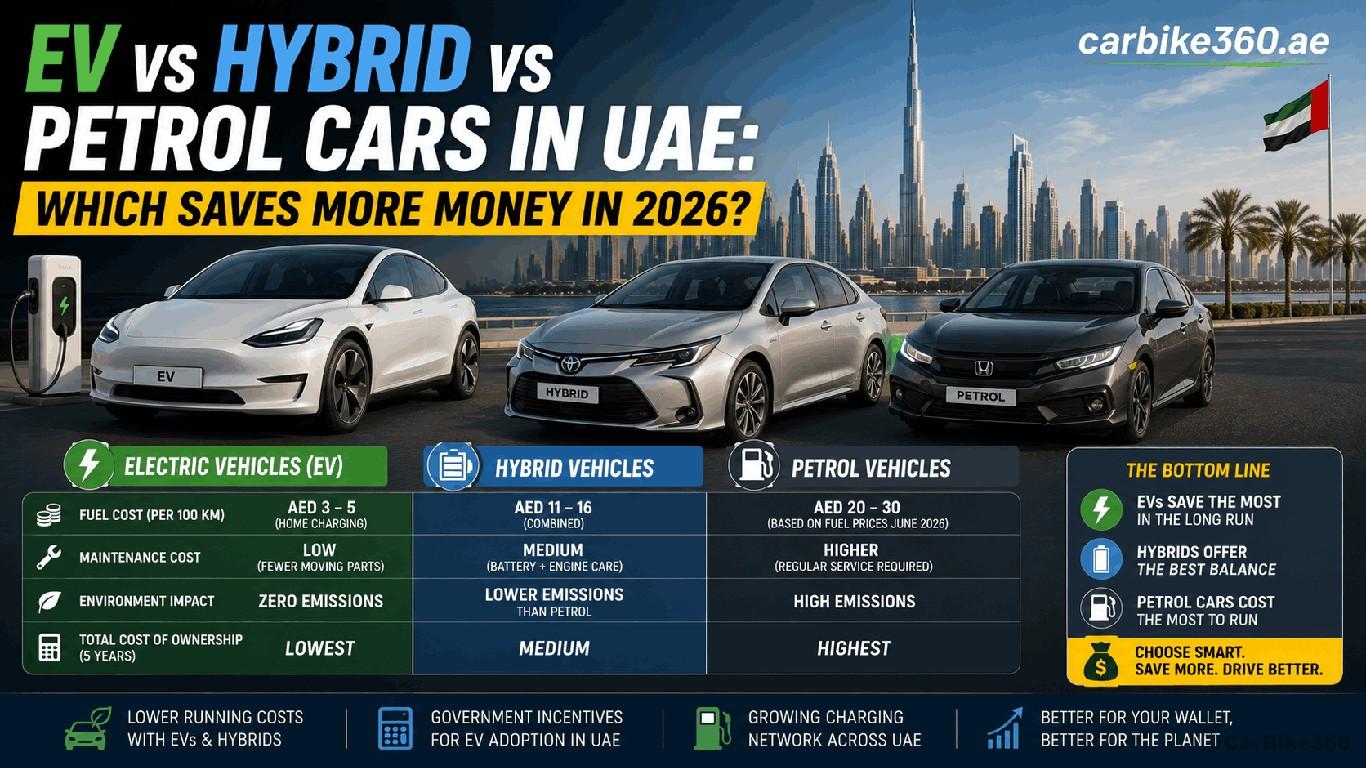
EV vs Hybrid vs Petrol Cars in UAE: Which Saves More Money in 2026?
Compare EVs, hybrids, and petrol cars in the UAE. Discover which vehicle type offers the lowest running costs, best fuel savings, maintenance benefits, and long-term value in 2026.
21-Jul-2026 01:37 PM












Join Carbike360
Get Trending Updates


UAE’s Fastest Growing Vehicle Marketplace