Key Facts to Understand About the Haval Chinese Automobile Brand






Key Highlights
-
Haval, a notable player in the global automotive industry, has prioritized SUVs and technological advancements.
-
The brand's lineup is currently powered by a range of turbocharged petrol engines, offering feature-rich SUVs.
-
Anticipation is high for Haval to introduce pure EV models into its lineup, especially in markets like the UAE where demand for Chinese cars and electric vehicles is rising.
-
Haval's trajectory underscores its commitment to innovation and meeting evolving consumer preferences worldwide.
Haval, a notable figure in the Chinese automotive sector, has a compelling narrative closely linked with the country's economic and technological advancement. Originating as a state-owned enterprise and evolving into a renowned global SUV frontrunner, Haval's trajectory exemplifies its responsiveness to market needs.
History
Haval's origins date back to 1983 when it emerged as a division of the Great Wall Motors Company, which was established by the Beijing Automobile Works. Initially, its primary objective was the manufacture of light trucks and SUVs branded as "Red Flag," with a strong emphasis on producing utilitarian vehicles tailored for government and industrial purposes.
During the 1990s, Haval pivoted towards civilian markets, launching its inaugural passenger SUV, the H6, in 1998. This pivotal moment set the stage for Haval's subsequent focus on SUVs, shaping its future strategic direction.
Haval Car Brand’s Market Boom
In the subsequent decade, Haval firmly established its presence in the Chinese market. The H6 consistently maintained its status among the top-selling SUVs in China, while the introduction of new models such as the H9, H2, and H8 broadened the brand's product range.
The design language of Haval's SUVs evolved to adopt a contemporary and refined aesthetic. The brand's success was underpinned by its commitment to research and development, with substantial investments made in new technologies and design expertise. This strategic focus resulted in the creation of innovative features like intelligent four-wheel drive systems and connected car technologies.
Haval Becomes A Standalone Brand
In March 2013, the Chinese SUV manufacturer transitioned into an independent brand after previously operating as a product line under the umbrella of Great Wall Motors. The remarkable success of the H6 SUV model, introduced in 2011, prompted Great Wall to separate Haval as its distinct brand, complete with a unique logo and identity. This strategic decision aimed to leverage the increasing demand for SUVs and position the brand as a formidable competitor in the market.
Global Chapter

Having established a robust presence domestically, Haval turned its attention to the global market in 2013. Expanding into new territories such as Russia, South Africa, and Australia, the brand relied on its flagship model, the H6, to spearhead its international endeavors. This global expansion was facilitated by a strategic emphasis on localization, wherein Haval tailored its vehicles and marketing approaches to cater to the unique requirements of each market.
Technological Advancements & Electrification
In recent years, Haval has placed a strong emphasis on technological advancements and embraced the trend of electrification. Through substantial investments in research and development, the company has introduced new features such as autonomous driving technologies and intelligent connectivity systems.
The brand's dedication to electrification is apparent in its expanding lineup of new energy vehicles (NEVs). Models like the H6 Hybrid and H9 Plug-in Hybrid mark Haval's entry into the hybrid segment, while the fully electric H6 EV and Jolion EV underscore its aspirations in the pure electric market.
The H6 HEV and H9 HEV have garnered positive reception in the Chinese market, with plans underway to introduce additional electric models in the years ahead.
Haval UAE’s Line-up
- Haval H6
- Haval H6 GT
- Haval H6 HEV
- Haval H9
- Haval Jolion
- Haval Drago

The feature-rich SUV lineup is currently propelled by a range of 1.5-liter and 2.0-liter turbocharged inline-4 petrol engines. While Haval has not yet incorporated a pure EV model into its lineup, it is anticipated to debut soon, especially considering the growing demand for Chinese cars and EVs in the UAE.
Verdict
Haval has emerged as a significant player in the global automotive industry, prioritizing SUVs and technological advancements. While currently powered by turbocharged petrol engines, the anticipation for pure EV models is on the rise, particularly in markets like the UAE where demand for Chinese cars and electric vehicles is increasing. Haval's trajectory reflects its commitment to innovation and meeting evolving consumer preferences worldwide.
Also Read: Review of the Pontiac Catalina: A Classic Muscle Car Paradise
More Articles
Why Software Is Becoming More Important Than Horsepower in Modern Cars
Discover why software is transforming the automotive industry in 2026. Learn how AI, connected features, over-the-air updates, and software-defined vehicles are becoming more important than horsepower.
12-Aug-2026 01:12 PM
Most Fuel-Efficient SUVs Available in UAE Today: Top Picks for 2026
Discover the most fuel-efficient SUVs available in the UAE in 2026. Compare hybrid and petrol models including Toyota RAV4 Hybrid, Corolla Cross Hybrid, Nissan Kicks, Hyundai Creta, Kia Seltos, and more.
11-Aug-2026 12:58 PM
Honda CR-V Saudi Arabia: Why Thousands of Families Are Choosing It in 2026
The 2026 Honda CR-V combines spacious seating, advanced safety, efficient performance, and premium comfort, making it one of the most practical family SUVs available in Saudi Arabia.
28-Jul-2026 06:06 AM
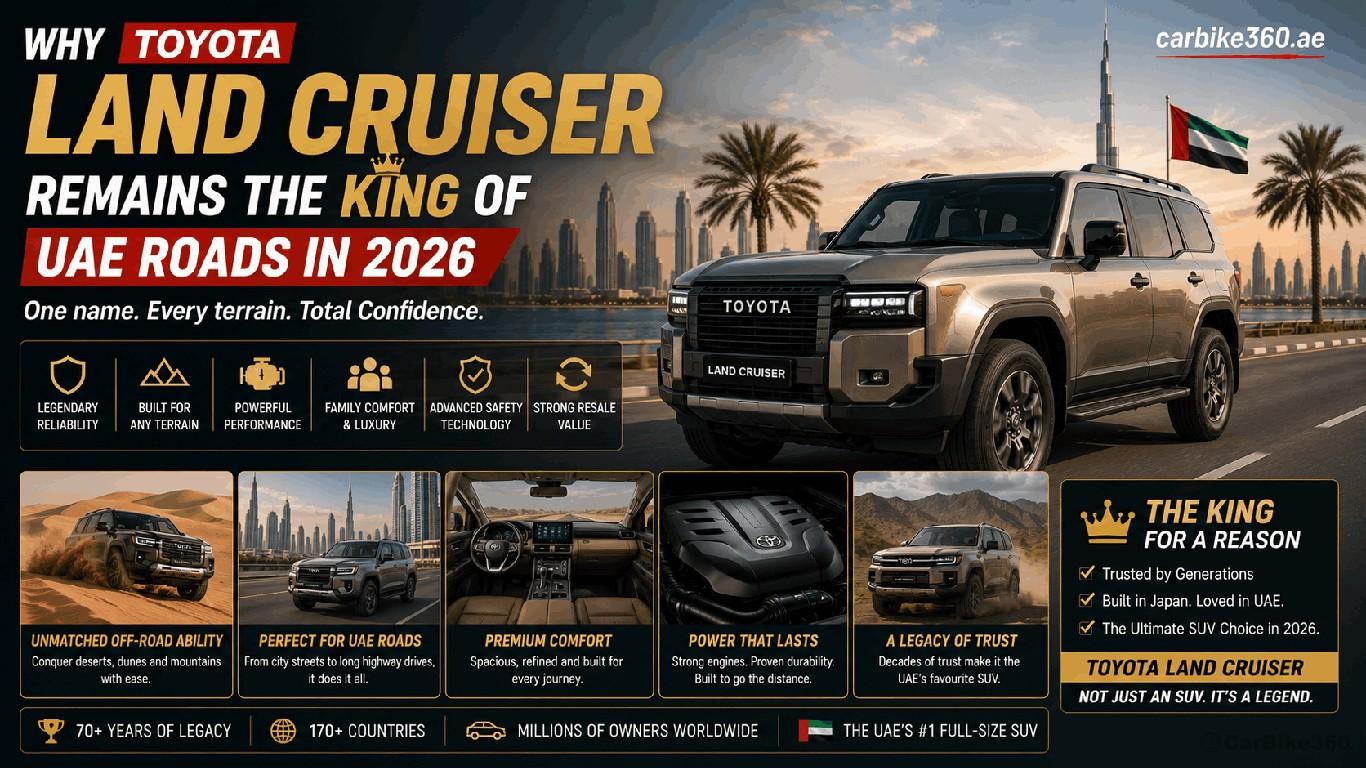
Why Toyota Land Cruiser Remains the King of UAE Roads in 2026
Discover why the Toyota Land Cruiser continues to dominate UAE roads in 2026. Explore its reliability, off-road capability, family-friendly features, resale value, and enduring popularity across the Emirates.
27-Jul-2026 09:54 AM
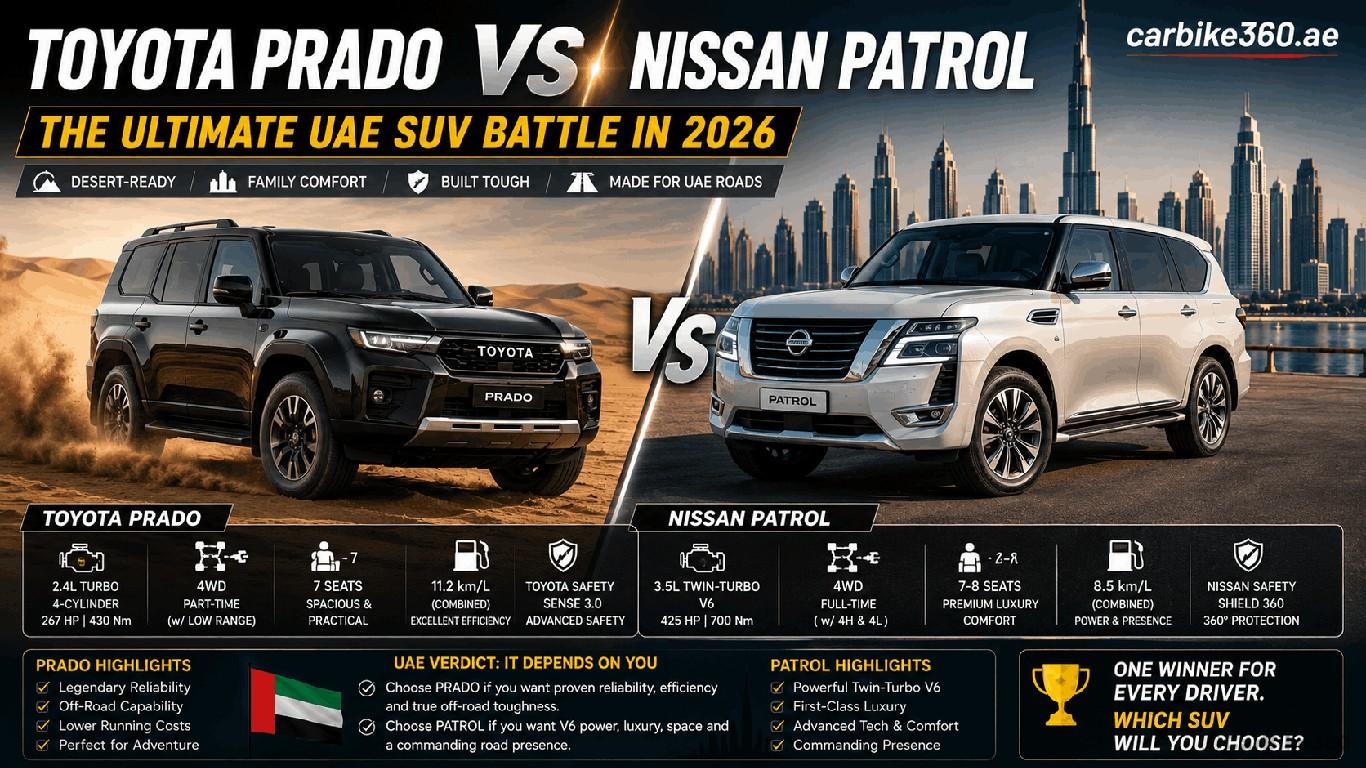
Toyota Prado vs Nissan Patrol: The Ultimate UAE SUV Battle in 2026
Toyota Prado or Nissan Patrol? Compare performance, off-road capability, luxury, fuel economy, resale value, and ownership costs to find the best SUV for UAE families in 2026.
24-Jul-2026 12:44 PM
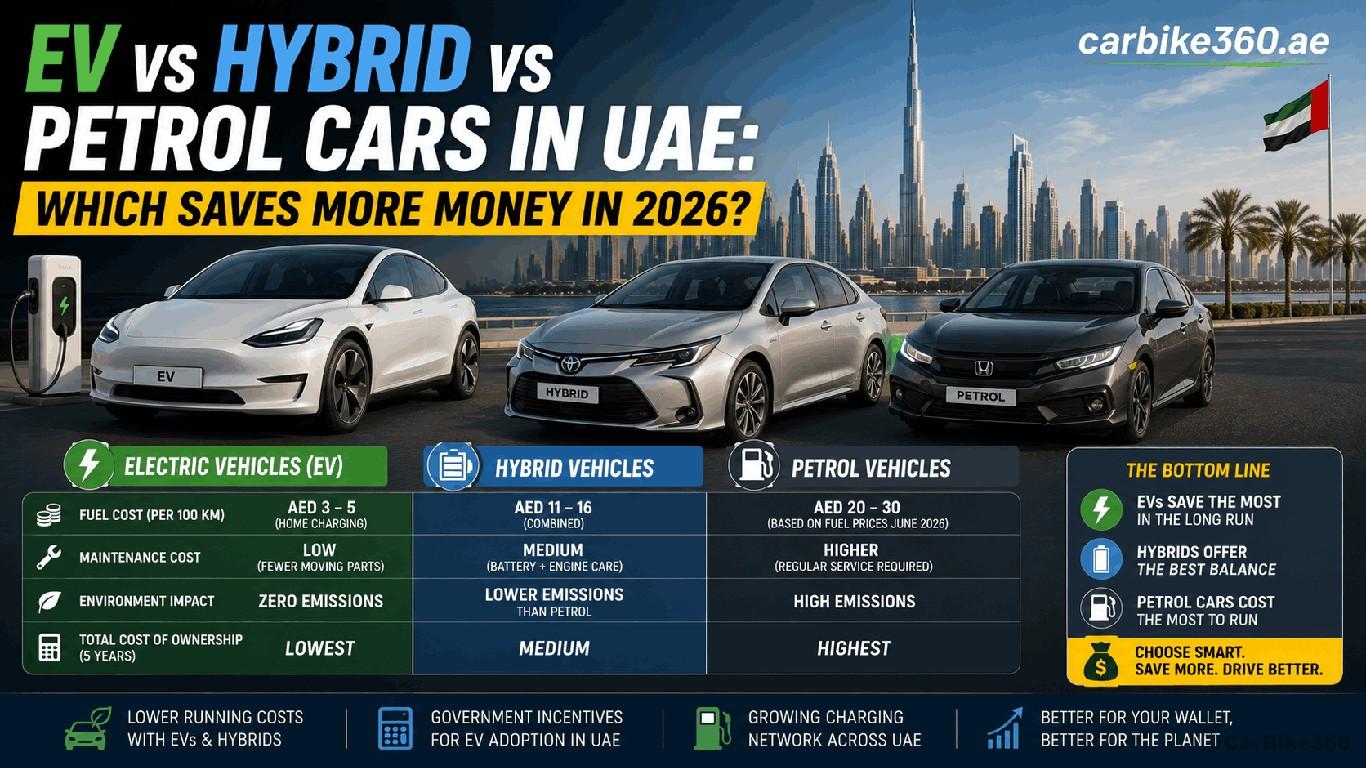
EV vs Hybrid vs Petrol Cars in UAE: Which Saves More Money in 2026?
Compare EVs, hybrids, and petrol cars in the UAE. Discover which vehicle type offers the lowest running costs, best fuel savings, maintenance benefits, and long-term value in 2026.
21-Jul-2026 01:37 PM




Join Carbike360
Get Trending Updates


UAE’s Fastest Growing Vehicle Marketplace