Electric Motors For Vehichles — A Reference To Automotive Terminology






Key Highlights
-
Liquid cooling (using water-glycol) is more effective than air cooling, allowing for higher power output and better efficiency.
-
Liquid cooling is ideal for high-performance EVs and hot climates due to its superior heat management.
-
Oil cooling is becoming popular for high-performance EVs but requires careful maintenance due to potential leaks.
-
Both liquid and oil cooling add complexity and weight to the vehicle and need regular maintenance for optimal performance.
Electric vehicles (EVs) are transforming the automotive industry at a swift pace. Central to these eco-friendly vehicles is the electric motor, an often overlooked component that converts electrical energy into the mechanical power needed to move the car. In contrast to the numerous components of internal combustion engines, electric motors are engineering marvels that provide a simpler and more efficient method of powering vehicles.
How Does an Electric Motor Work?
Electric motors in cars come in different types, but they all operate on the principle of magnetism. There are two main parts: the stator and the rotor. The stator is the stationary part with electromagnets made by coils of wire. When electricity flows through these coils, it creates a rotating magnetic field.
The rotor is the part that spins and usually has a permanent magnet or an electromagnet. The interaction between the stator's rotating magnetic field and the rotor's magnet causes the rotor to turn, producing mechanical energy.
Advantages of Electric Motors in Cars
Electric motors have several benefits over traditional combustion engines:
- Efficiency: Electric motors convert more electrical energy into mechanical energy than gasoline engines, which means better range and lower energy use.
- **Performance: **They provide instant torque, ensuring smooth, responsive driving and good acceleration.
- Quiet Operation: Electric motors are much quieter, leading to a more peaceful drive and less noise pollution.
- Lower Maintenance: With fewer parts that move, electric motors need less maintenance compared to combustion engines.
- Water Resistance: Electric motors in EVs often use waterproof materials and seals, enhancing their resistance to water. Some even have an IP (Ingress Protection) code, showing their level of protection against water and dust.
Types of Electric Motors for Cars
Permanent Magnet Synchronous Motor (PMSM): This type is popular for its high efficiency and power density. It uses permanent magnets in the rotor that interact with the stator's rotating magnetic field to provide smooth and strong torque.
Induction Motor (AC Motor): Known for being durable and cost-effective. The rotor’s current is induced by the stator's rotating magnetic field, resulting in a simpler design but slightly lower efficiency compared to PMSMs.
Brushless DC Motor (BLDC Motor): Known for precise control over speed and torque. Like PMSMs, they use permanent magnets in the rotor but are controlled electronically to achieve variable speeds.
How Do Electric Motors Transmit Power to the Wheels?

Electric motors in cars use two main methods to transmit power to the wheels:
Gearbox & Driveshaft (Traditional): Similar to gas cars, the motor spins a shaft connected to a gearbox. This boosts the engine's speed and torque, which is then delivered to the wheels through a driveshaft and differential.
- Pros: Simple and scalable.
- Cons: Less efficient and heavier.
In-Wheel Motors (Direct Drive):
This method places electric motors directly in the wheels, removing the need for a gearbox and driveshaft, which can lead to better efficiency and more flexible design options.
- Pros: More efficient and saves space.
- Cons: Complex, relatively new technology, and more expensive.
Different Configurations for Electric Motors in Cars
Electric cars have various ways to deliver power. Here are the different motor configurations and placements:
By Number of Motors
Single Motor: Common in budget-friendly EVs. Usually placed on the front axle for front-wheel drive (FWD) efficiency, but can also be placed on the rear axle for rear-wheel drive (RWD).
Dual Motor: Provides all-wheel drive (AWD) for better handling and performance. One motor is placed on each axle (front and rear) or a larger motor on the front axle paired with a smaller motor on the rear.
Triple or Quad Motor: Used in high-performance setups for maximum acceleration and handling. Often involves two motors on the rear for independent control and one motor on the front.
Motor Placement
Front-Wheel Drive (FWD): The motor is placed near the front wheels, providing a familiar driving experience and convenient packaging.
Rear-Wheel Drive (RWD): The motor is positioned near the rear wheels, offering a sportier driving feel.
All-Wheel Drive (AWD): This can be achieved with different setups, such as having dual motors (one on each axle) or a single motor at the front with additional motors at the rear wheels.
How Do Electric Cars Go in Reverse?
Electric cars don't use a traditional "reverse gear" like gasoline cars. Instead:
- The electric motor can run in both directions. By changing the direction of the electrical current in the motor’s coils, the magnetic field flips, making the motor spin backward.
- This reversed rotation makes the wheels spin in reverse, allowing the car to move backward.
Types of Cooling for Electric Motors in Cars

Electric motors in cars produce heat when they run, and it's important to keep them cool for best performance and durability. Here are the main ways they are cooled:
Air Cooled Electric Motors:
- Simple and cost-effective method.
- Uses fins or channels on the motor casing to release heat through airflow, which can be from the car’s motion or fans.
- Works well for motors with lower power or where weight is critical.
- Drawbacks: Not as efficient at cooling as liquid cooling, especially for high-performance uses.
Oil Cooled Electric Motors:
- Oil cooling for electric motors has become popular recently, especially in high-performance EVs.
- It's like liquid cooling but uses oil instead of water-glycol because oil can absorb and transfer heat more effectively.
- It's often used alongside a water-glycol system that cools the battery pack and inverter, creating a comprehensive thermal management setup.
- However, oil leaks can be more troublesome than coolant leaks, and the system may need extra maintenance.
Liquid Cooled Electric Motors:
- Liquid cooling for electric motors is more efficient at removing heat than air cooling, which allows for higher power output and improved efficiency.
- A coolant, usually a mix of water and glycol, flows through a jacket around the motor, absorbing heat.
- The heated coolant then moves to a radiator, where airflow outside the car removes the heat from the liquid.
- This method is widely used in high-performance EVs and in EVs operating in hot weather.
- However, it makes the car’s thermal management system more complex and heavier.
Verdict
Choice of cooling method significantly impacts the performance and efficiency of electric motors in cars. While air cooling remains simple and cost-effective, liquid cooling, particularly with water-glycol mixtures, offers superior heat dissipation capabilities crucial for high-performance and hot climate applications.
Oil cooling, emerging as an alternative for high-performance EVs, leverages oil's higher heat capacity but requires careful maintenance due to potential leakage issues. Each cooling method represents a balance between efficiency, complexity, and maintenance considerations, tailored to meet the specific demands of modern electric vehicle designs.
Also Read: 10 Rivals To The Porsche 911: Challenging The Iconic Champion
More Articles
Why Software Is Becoming More Important Than Horsepower in Modern Cars
Discover why software is transforming the automotive industry in 2026. Learn how AI, connected features, over-the-air updates, and software-defined vehicles are becoming more important than horsepower.
12-Aug-2026 01:12 PM

Most Fuel-Efficient SUVs Available in UAE Today: Top Picks for 2026
Discover the most fuel-efficient SUVs available in the UAE in 2026. Compare hybrid and petrol models including Toyota RAV4 Hybrid, Corolla Cross Hybrid, Nissan Kicks, Hyundai Creta, Kia Seltos, and more.
11-Aug-2026 12:58 PM

Honda CR-V Saudi Arabia: Why Thousands of Families Are Choosing It in 2026
The 2026 Honda CR-V combines spacious seating, advanced safety, efficient performance, and premium comfort, making it one of the most practical family SUVs available in Saudi Arabia.
28-Jul-2026 06:06 AM

Why Toyota Land Cruiser Remains the King of UAE Roads in 2026
Discover why the Toyota Land Cruiser continues to dominate UAE roads in 2026. Explore its reliability, off-road capability, family-friendly features, resale value, and enduring popularity across the Emirates.
27-Jul-2026 09:54 AM

Toyota Prado vs Nissan Patrol: The Ultimate UAE SUV Battle in 2026
Toyota Prado or Nissan Patrol? Compare performance, off-road capability, luxury, fuel economy, resale value, and ownership costs to find the best SUV for UAE families in 2026.
24-Jul-2026 12:44 PM
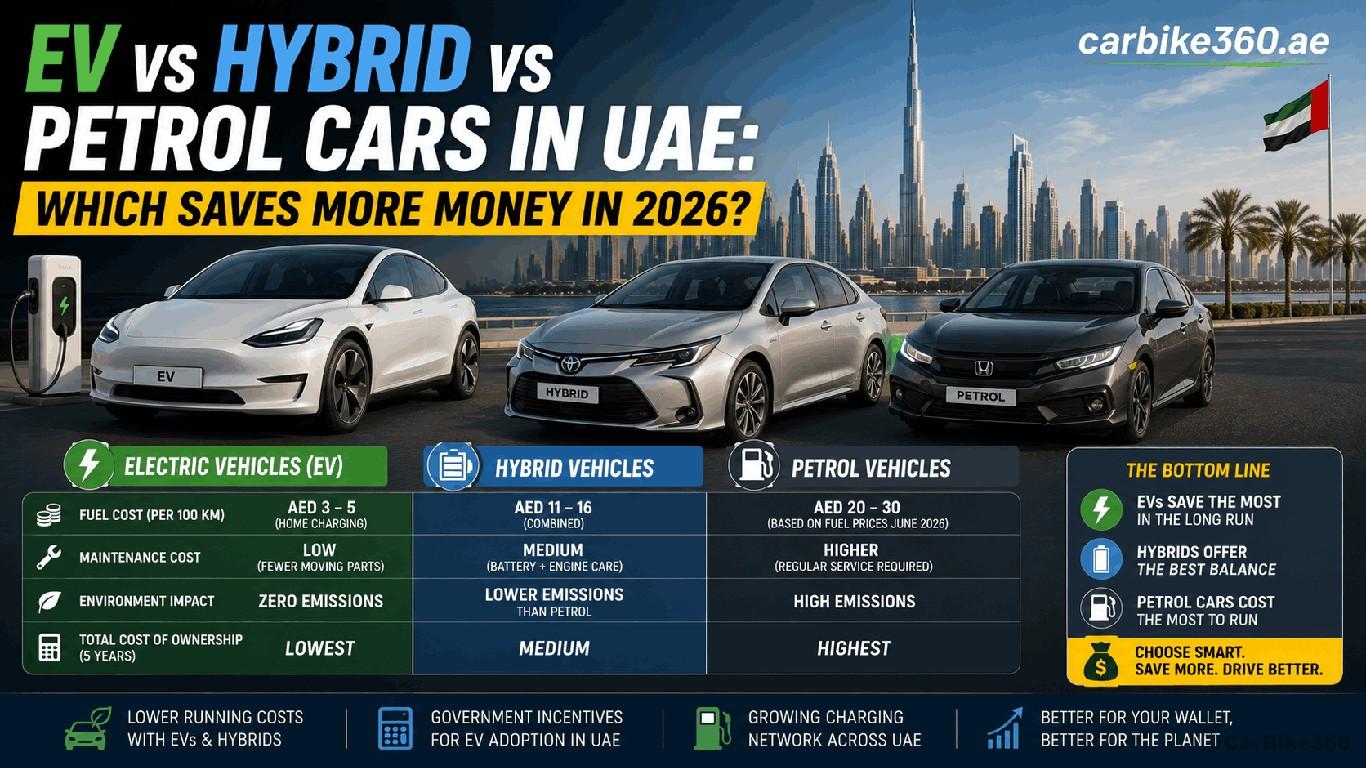
EV vs Hybrid vs Petrol Cars in UAE: Which Saves More Money in 2026?
Compare EVs, hybrids, and petrol cars in the UAE. Discover which vehicle type offers the lowest running costs, best fuel savings, maintenance benefits, and long-term value in 2026.
21-Jul-2026 01:37 PM







Join Carbike360
Get Trending Updates


UAE’s Fastest Growing Vehicle Marketplace